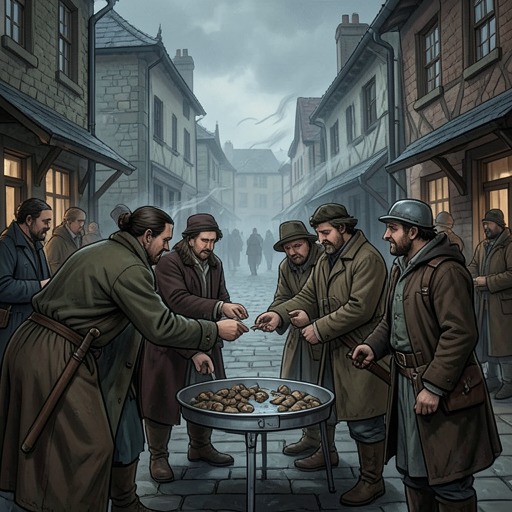
Post-war rationing and informal exchange of goods
A Murder Is AnnouncedPost-war rationing and informal exchange of goods are not merely social background in the novel: they organize domestic choices, neighborly favors, and movement between houses, placing the murder investigation inside a village economy where practical errands can also create opportunities and alibis. Fuel restrictions, food-sharing, and covert barter make scarcity a daily condition, while the habits formed around them complicate the police effort to determine who has been where and why.
Household scarcity and rationing
The shortage of fuel is made tangible through the decision to light the central heating on a damp, misty day. Miss Blacklock explains that she had asked Evans to light it before he left; Patrick immediately mocks the use of “precious coke.” Her answer makes the constraint plain: coal is even more precious, and the Fuel Office will not issue the small weekly allowance unless the household can say it has no other means of cooking. The exchange shows scarcity governing even a seemingly ordinary domestic comfort, and makes the household’s fuel supply a matter of calculation rather than abundance.
That present-day economy is set against an imagined past. Julia listens to the account of plentiful, cheap coke and coal as though hearing about another country, while Miss Blacklock confirms that fuel was once abundant. The contrast marks a generational divide: the younger woman has no lived reference for the earlier plenty, and the older woman’s recollection measures how sharply everyday provision has changed.
The household’s arrangements also reflect the period’s altered domestic labor. Patrick and Julia, distant cousins rather than the children Miss Blacklock calls them, have been paying guests for only two months. They came after the war at their mother’s request: Patrick studies engineering at Milchester University, while Julia is training as a dispenser at Milchester General Hospital. Their contribution helps make the large house workable for its owner, who says she is glad to have someone young there. Phillipa Haymes is lodged there because the cottage at Dayas Hall is occupied by the old gardener and his wife; she works as an assistant gardener and is a widow whose eight-year-old son stays with her during school holidays. These practical household placements show how work, lodging, and family circumstances intersect in a village adapting to post-war conditions.
Everyday exchange between neighbors
A visit to Little Paddocks can be part of an ordinary exchange rather than an exceptional intrusion. Mrs Swettenham arrives through the side door with quinces for Miss Blacklock, who wants to make quince jelly despite having no quince tree of her own. She explains that neighbors commonly walk in and out of one another’s houses, leaving goods even when the host is absent. The practice is convenient, but it also means that an open door and an unexplained visit cannot by themselves distinguish a friendly errand from suspicious access.
Food moves through several overlapping favors. Miss Blacklock, returning from Milchester by car, brings horse meat for Mrs Swettenham and leaves it on the kitchen table for her to collect. Mrs Swettenham prefers to fetch it when Mitzi is not there, because Mitzi can be rude. The detail gives the exchange a precise route and a small interpersonal complication: the favor depends not only on supply and transport but also on choosing a moment when the person at home will not obstruct it.
Other routine activity creates similarly plausible access. Miss Murgatroyd says she came with a hen to sit on eggs, an errand that leaves her flustered and apparently inconsistent when questioned. Miss Hinchcliffe initially says she has not been at Little Paddocks lately, but Mitzi and a local woman have seen her coming out of the side door; she then allows that she may have visited and forgotten why. These accounts sit within a culture of casual visiting, where brief, unremarkable calls are common enough to be forgotten or hard to date precisely.
Barter, concealment, and local knowledge
The village’s exchange network is more organized than a succession of spontaneous favors. Bunch explains that one of the farms makes butter on Thursdays and lets trusted people have some. Miss Hinchcliffe, who is close to the farmers through her pigs, often collects it. Goods may then be exchanged for cucumbers or other produce, and a little something may be passed along when a pig is killed. If an animal has to be destroyed after an accident, its meat can enter the same informal system. The arrangement is distributed across farms and households rather than conducted through a single market, and its participants rely on personal ties to know what is available and where it should go.
A note from Miss Blacklock turns this hidden routine into evidence. It says that Thursday is the day and that anything intended for her should be left after three in the usual place. Bunch identifies that place as a flour bin beneath the dresser, though it does not contain flour. The note’s concise instructions make sense once the barter network is understood: a message that might otherwise seem cryptic records the timing and drop-off point for an informal delivery. An ordinary household container serves as the system’s discreet point of exchange.
Clothing coupons once provided another means of payment. Bunch describes people exchanging coupons for a woollen dress or a winter coat that had not been worn much, rather than paying money; she distinguishes this practice from buying coupons, which was considered dishonest. The arrangement shows scarcity producing its own forms of valuation: access to a rationed entitlement can matter more than cash, and a used garment can circulate through a personal network rather than a shop.
The exchanges are deliberately kept quiet because some forms of barter may be illegal. Bunch observes that it is difficult to explain the scheme directly to the police, while also arguing that the laws are unreasonable. She says she does not participate because Julian dislikes it, although she knows what is happening. The distinction between knowledge and participation matters: information about the network is widespread, but people’s actions and willingness to describe them differ. For Craddock, investigating a household means entering a world whose ordinary arrangements are only partly visible to an outsider.
Access, investigation, and narrative significance
The village’s habits of hospitality shape the practical investigation. At Little Paddocks, the side door is usually left unlocked during summer and, in the season of the crime, is shut but not locked; people use it frequently, and it is locked only after someone comes in. Miss Blacklock sometimes goes out to shut the ducks and hens, though she often uses the kitchen door. Against that pattern, neighbors carrying food, fetching a favor, or calling briefly have plausible reasons to enter without ceremony. The distinction between access and intrusion is therefore difficult to establish from a door’s condition alone.
The detectives’ inquiries run directly into this problem. Fletcher checks who could have oiled the drawing-room door and which visitors had been at the house while Mitzi was out. But Mitzi often takes an afternoon walk to the village for coffee at the Bluebird, while Miss Blacklock and Miss Bunner are frequently out blackberrying. Their overlapping absences leave intervals when the house is unattended. Routine movement through the village, rather than a single exceptional breach, creates the opportunity the inquiry must assess.
Even a small delivery can complicate a witness’s account. Mrs Swettenham’s visit to collect the horse meat is consistent with the familiar exchange practice, while Miss Hinchcliffe’s uncertain recollection of a visit becomes significant because others remember seeing her. The same social world that makes these visits normal also produces imperfect records: residents enter through side doors, leave items in agreed places, and may not remember a brief call as a distinct event. The police have to test statements against local routines rather than treating every visit as self-explanatory.
The result is an atmosphere in which the ordinary and the evidentially important share the same channels. Butter may be left in a flour bin, quinces in a dining room, or horse meat on a kitchen table; a neighbor may come for a favor, an animal, or a pattern. Such exchanges make the village feel cooperative and self-sufficient, but they also blur the boundaries of access and concealment. The investigation’s difficulty is not that daily life stops under the pressure of crime, but that its established habits continue, supplying both innocent explanations and opportunities that must be distinguished from them.